
The economy, though projected to grow 9.6 per cent in the next financial year in year-on-year growth term, may grow just 1 per cent in real terms to Rs 147.17 lakh crore as against Rs 145.66 lakh crore in 2019-20, at the 2011-12 prices, according to a report by India Ratings. The size of the economy, as per the National Statistical Office's data, had stood at Rs 145.66 lakh crore in 2019-20, at the 2011-12 prices. According to the rating agency, the country's gross domestic product (GDP) is expected to contract 7.8 per cent to Rs 134.33 lakh crore in 2020-21, but may grow 9.6 per cent to Rs 147.17 lakh crore in 2021-22.

Going forward, the February factory output may be impacted as several industries such as automobiles, technology, pharma and fashion have some exposure to imports of raw and intermediate materials from China.

Production grew by a mere 0.5 per cent year-on-year, a significant comedown from the 3.5 per cent clocked in June.

On growth, the Governor said the prospects in the last few months have improved.

'Everyone confuses GDP to be a measure of output, when it is actually a measure of income.'

The wholesale price-based inflation shot up to an all-time high of 10.49 per cent in April, on rising prices of crude oil and manufactured items. Also, a low base of April last year contributed to the spike in inflation in April 2021. The WPI inflation was 7.39 per cent in March 2021, and (-) 1.57 per cent in April 2020. This is the fourth straight month of uptick seen in the wholesale price index (WPI)-based inflation.

The NSE Nifty settled the day 96.80 points, or 0.94 per cent lower, at 10,224.95

The wholesale price-based inflation rose to an eight-month high of 1.48 per cent in October, as manufactured products turned costlier. The WPI inflation was 1.32 per cent in September and zero per cent in October last year. This is the highest level of wholesale price index-based (WPI) inflation since February when it was 2.26 per cent.

Among other things, the agenda is likely to focus on increasing private investment, employment generation and giving relief to the farm sector

It has mostly been a one-way street for markets that have moved up sharply since July. The front-line indices - the S&P BSE Sensex and the Nifty50 - have gained 6.7 per cent and 7.3 per cent, respectively, in the past three months. The rally in mid- and small-caps has been sharper, with both indices surging 14 per cent and 9 per cent, respectively, during this period. This sharp run has made analysts at Jefferies cautious.

The mismatch between PMI and core sector could also be due to the fact that while core sector is calculated year-on-year, PMI is calculated month-on-month.

'Market feels this Budget will promote all-round growth and that is what is giving it confidence.'

The new IIP numbers should spread cheer among those who were part of the Manmohan Singh-led United Progressive Alliance, earlier accused of having presided over a steady deterioration in industrial performance, particularly in the last two years of its tenure, says A K Bhattacharya.

'Very few of small investors stay invested for those three or four or five years.' 'If there's like a six month, one-year period when market is not doing well, you exit.' 'After the market has run up, you get in again.' 'This way you will never make returns.'

Backed by the China-plus-one policy, India's textile and apparel exports have seen a 53 per cent growth during the April-November period of the current fiscal year at around $26 billion. This compares to the figure of $17 billion during the same period in FY21. According to Wazir Textile Index, all major companies including Welspun, Vardhman, Trident, KPR Mills, Indo Count, RSWM, Filatex, Nahar Spg and Indorama have posted higher sales during the first half of the current fiscal year compared to the pre-pandemic year.

Input shortages and low inventories, according to Nomura, will likely lead to production cuts and delayed shipments in the September 2021 quarter.

Indirect tax revenues rose marginally by 5.6 per cent in the April-October period to over Rs 2.85 lakh crore, mainly on account of increase in service tax and customs collections.

Softening inflation, Das said would make available more policy space to the central bank to address risks to the growth going forward.

Sentiment took a dramatic change particularly in the last one hour of trading with the lower opening of the European markets and investors booking profits in broader markets at record levels

The shortage of semiconductors globally is expected to persist through 2021 and recover to normal levels by the second quarter of 2022, which will constrain the production of many electronic equipment types this year, according to research firm Gartner. Semiconductors play a crucial role in everything, right from computers to appliances, communication devices, transportation systems to critical infrastructure. The breakout of the COVID-19 pandemic had temporarily disrupted semiconductor shipments.

Created over the past 12-15 months, Niti's new Export Preparedness Index flagged the major intra-and inter-regional disparities in export infrastructure, problems in trade support and lack of unique exports as the main challenges hampering export growth.

ITC has been one of the best performing large-cap stock at the bourses thus far in calendar year 2022 (CY22), rallying nearly 52 per cent during this period and outperforming the sector benchmark - the S&P BSE FMCG index - by a wide margin that moved up around 17 per cent during this period. However, the counter has lost over 5 per cent from its recent high of Rs 346.25 hit on September 23, 2022 and has underperformed the S&P BSE Sensex, which has lost nearly 2 per cent since then. So, is the rally in the stock coming to an end, and is this a good time to book profit?

India's manufacturing sector activities gained further strength in November, and witnessed the strongest increase in production and sales since February on improving market conditions, a monthly survey said on Wednesday. The seasonally adjusted IHS Markit India Manufacturing Purchasing Managers' Index (PMI), increased from 55.9 in October to 57.6 in November, signalling the strongest improvement in the health of the sector in ten months. Moreover, the headline figure was well above its long-run average of 53.6.

The breadth, indicating the overall health of the market, was slightly positive
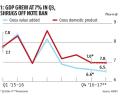
It is difficult to reconcile the GDP numbers with other economic indicators.

Loans, cash credits, and overdrafts at the end of December 22, 2017, stood at Rs 81,287.32 billion, against Rs 73,340 billion in the year-ago period.

The imposition of 15 per cent export duty on steel has suddenly altered the prospects of the sector to negative and led to a big sell-off in steel stocks. Iron ore and pellet exports have to face duties of 45-50 per cent, which means they become uncompetitive. The Ukraine war has led to a supply crunch in global markets and pushed up prices, with Europe, in particular, looking for replacements for Ukrainian and Russian exports.

A government panel examined the records of employees surveyed by Labour Bureau's quarterly enterprises surveys and mapped it with the EPFO's subscribers and found "unexplained variations" between the two.

Top losers include Hero MotoCorp, HDFC, SBI, Infosys, HCL Tech, ICICI Bank, Bajaj Finance, ONGC, Bajaj Auto and IndusInd Bank, falling up to 2.63 per cent.

The headline seasonally adjusted IHS Markit India Manufacturing Purchasing Managers' Index (PMI) fell to a two-year low of 50.6 in October from 51.4 in September.

Despite near-term headwinds of rising input costs and the possibility of lower demand for products as Covid dented rural & urban India, and impacts both production & consumption, analysts remain bullish on stocks of fast moving consumer goods (FMCG) companies and expect the index to relatively outperform its peers in the second half of fiscal 2021-22 (FY22). In the past one year, prices of key commodities such as groundnut oil, mustard oil, Vanaspati, soya oil, sunflower oil and palm oil have shot up in the range of 20 per cent to 60 per cent, data show. The FMCG sector macros in this backdrop, according to analysts, have further deteriorated because of weakness in consumer demand and likely margin pressure due to elevated crude oil, palm oil and global food prices.

Omkeshwar Singh, Head, Rank MF, a mutual fund investment platform, answers your queries.

Onion prices, however, continued to rule high with 79.78 per cent increase in September.
.jpg)
The marginal improvement in the index of industrial production was mainly on account of higher power generation and mining sector output, while manufacturing declined.

Reflecting a loss of "growth momentum", manufacturing activities in the country slowed down to a six-month low in March amid softer increases in new orders, production and employment, according to a survey.

Eight infrastructure industries have posted a growth rate of 8 per cent for September on account of good performance by crude oil, steel and electricity sectors.

According to a commerce and industry ministry statement, the growth rate for these eight key sectors for April 2019 has been revised upward to 6.3 per cent from 2.6 per cent reported earlier mainly due to upward revisions in production of coal, crude oil, steel, cement and electricity.

In February last year, it was (-)2.17 per cent.

Raghuram Rajan, who was Chief Economic Advisor in the Finance Ministry before taking over as RBI Governor on September 4, is scheduled to announce the next mid-quarter policy review on December 18.

Bombay Stock Exchange Sensex closed 30 points lower at 21,140 levels.
